
Living with uncontrolled seizures affects every part of a person’s life — driving, working, studying, and even sleeping safely. If medications have not stopped your seizures, you may be wondering whether surgery is an option. The answer, for many patients, is yes.
Epilepsy surgery in India has become increasingly accessible, with world-class outcomes available at a fraction of the cost compared to Western countries. This guide explains who qualifies, what the surgery involves, how much it costs, and what results you can realistically expect.
What Is Epilepsy Surgery?
Epilepsy surgery is a procedure that removes or disconnects the specific area of the brain responsible for triggering seizures. It is considered when a patient’s seizures do not respond to two or more appropriately prescribed anti-epileptic medications — a condition known as drug-resistant epilepsy or refractory epilepsy.
Contrary to what many patients fear, epilepsy surgery is not a last resort born out of desperation. It is a carefully planned, evidence-based treatment that has helped millions of patients worldwide achieve seizure freedom or a significant reduction in seizure frequency.
Who Is a Candidate for Epilepsy Surgery?
Not every patient with epilepsy requires surgery. You may be a suitable candidate if:
- You have been diagnosed with drug-resistant epilepsy (seizures continue despite trying two or more medications at adequate doses)
- Investigations identify a clear seizure focus — a specific, locatable area of the brain where seizures originate
- The seizure focus is in an area that can be safely removed without causing unacceptable neurological deficits
- Your quality of life is significantly impaired by ongoing seizures
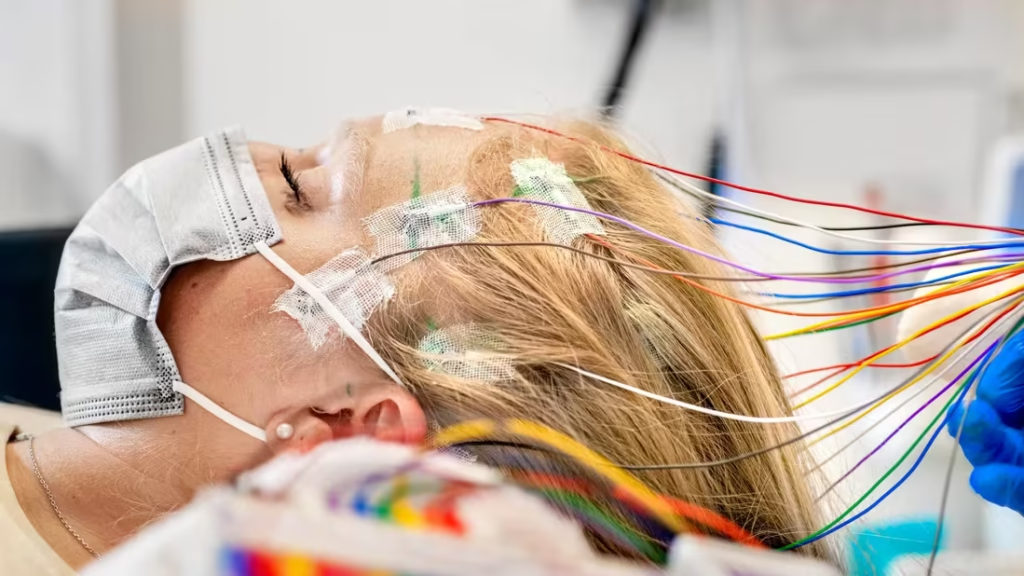
The evaluation process typically involves a detailed MRI of the brain, video-EEG monitoring, neuropsychological testing, and in some cases advanced imaging such as PET or SPECT scans. This pre-surgical workup is critical — it is what determines whether surgery will be safe and effective for your specific case.
Types of Epilepsy Surgery
The right surgical approach depends entirely on where seizures originate and how the brain is organised around that area.
Temporal lobe resection is the most common procedure, performed when seizures arise from the temporal lobe. It has the highest success rate of all epilepsy surgeries — up to 70–80% of patients achieve complete seizure freedom.
Lesionectomy involves removing a specific brain lesion (such as a cavernoma, tumour, or scar tissue) that is the identified seizure source. Outcomes are very good when the lesion is well-defined.
Hemispherectomy and hemispherotomy are performed in children with severe epilepsy affecting one entire hemisphere of the brain. Despite sounding extreme, results can be remarkable — many children become seizure-free and continue to develop normally.
Corpus callosotomy does not remove brain tissue but instead cuts the connection between the two brain hemispheres, preventing seizures from spreading. This is typically offered for patients with drop attacks (atonic seizures) that cause falls and injuries.
Deep Brain Stimulation (DBS) and Vagus Nerve Stimulation (VNS) are neuromodulation approaches used when resective surgery is not possible. A device is implanted that delivers electrical impulses to modulate brain activity.
Epilepsy Surgery Success Rate in India
One of the most common questions patients and families ask is: does it actually work?
The answer depends on the type of surgery and how carefully the patient is selected:
| Type of Surgery | Seizure-Free Rate |
|---|---|
| Temporal lobe resection | 70 – 80% |
| Lesionectomy | 75 – 90% |
| Hemispherectomy (children) | 60 – 80% |
| Corpus callosotomy | 50 – 80% reduction in drop attacks |
| VNS / DBS | 30 – 50% reduction |
It is important to understand that “success” does not always mean complete seizure freedom. For many patients, a 50–80% reduction in seizure frequency is life-changing — allowing them to drive, work, and live independently for the first time in years.
Indian surgical outcomes for epilepsy surgery are comparable to the best international centres. With proper pre-surgical evaluation and an experienced neurosurgical team, the results in India are excellent.
Epilepsy Surgery Cost in India
One of India’s greatest advantages as a medical destination is cost. Epilepsy surgery in India costs a fraction of what the same procedure would cost in the USA, UK, or Australia — without any compromise in surgical quality or outcomes.
| Procedure | Estimated Cost in India |
|---|---|
| Pre-surgical evaluation (MRI, video-EEG, neuropsychology) | ₹40,000 – ₹1,20,000 |
| Temporal lobe resection | ₹2,00,000 – ₹4,50,000 |
| Lesionectomy | ₹2,50,000 – ₹5,00,000 |
| Hemispherectomy | ₹4,00,000 – ₹8,00,000 |
| VNS implantation | ₹5,00,000 – ₹10,00,000 |
These figures include surgeon fees, anaesthesia, hospitalisation, and standard post-operative care. Costs vary depending on the hospital, the complexity of the case, and whether advanced intra-operative monitoring (such as awake craniotomy or electrocorticography) is required.
Compared to the USA where the same surgery typically costs $50,000–$150,000 (₹40–₹1.2 crore), India offers dramatically better value with internationally trained surgeons and modern infrastructure.
What to Expect: Before, During & After Surgery
Before Surgery
The pre-surgical workup is thorough and typically takes several weeks to complete. It includes:
- High-resolution MRI to identify structural abnormalities
- Video-EEG monitoring to record and localise seizures during a hospital admission (usually 5–10 days)
- Neuropsychological evaluation to map cognitive function and identify any risks to memory or language
- Functional MRI or Wada test to determine language and memory dominance, if required
- PET or SPECT scan in complex cases to confirm the seizure focus
This evaluation is as important as the surgery itself. It is what makes the difference between a successful outcome and an avoidable complication.
During Surgery
Most epilepsy surgeries are performed under general anaesthesia and last 3–6 hours depending on the procedure. In some cases — particularly when the seizure focus is near areas controlling language or movement — an awake craniotomy technique is used. The patient is kept awake and responsive during part of the procedure so that the surgeon can map and protect critical brain functions in real time.
Intra-operative electrocorticography (ECoG) — recording directly from the brain surface during surgery — is used to confirm complete removal of the seizure focus.
After Surgery
Recovery from epilepsy surgery varies by individual and procedure type:
- ICU stay: 1–2 days for observation
- Hospital stay: 5–7 days on average
- Return to light activity: 4–6 weeks
- Full recovery: 3–6 months
Anti-epileptic medications are typically continued for at least 1–2 years after surgery, even in seizure-free patients, before a gradual taper is considered. Regular follow-up with the neurosurgical team is essential.
Some patients experience temporary side effects after surgery including headaches, fatigue, mood changes, or mild memory difficulties — most of these resolve within a few months. Serious permanent complications are uncommon when surgery is performed by an experienced epilepsy surgeon at a well-equipped centre.
Risks of Epilepsy Surgery
Like all brain surgeries, epilepsy surgery carries risks. These must be weighed honestly against the ongoing risks of uncontrolled seizures — which include injuries, sudden unexpected death in epilepsy (SUDEP), and profound limitations on quality of life.
Common risks include:
- Infection (rare with modern sterile technique)
- Bleeding
- Temporary or mild cognitive changes, particularly memory
- Mood changes during recovery
Serious risks such as stroke, significant neurological deficit, or vision field changes are uncommon and depend heavily on the location of the surgery and the experience of the surgical team. A thorough pre-surgical evaluation specifically aims to identify and minimise these risks before the procedure is undertaken.
Why Choose Dr. Shyam for Epilepsy Surgery in Tamil Nadu?
Dr. Shyam D is a board-certified neurosurgeon based in Madurai with over a decade of experience in complex brain and spine surgery. He holds:
- M.Ch. (Neurosurgery) with multiple Gold Medals
- IFAANS — International Fellow, American Association of Neurological Surgeons
- FACS — Fellow, American College of Surgeons
- Fellowship in Cerebrovascular Surgery, Japan
- Training in Advanced Skull Base Surgery, USA
Dr. Shyam performs the full spectrum of epilepsy surgery procedures — from temporal lobe resections and lesionectomies to corpus callosotomy and neuromodulation — with access to advanced intra-operative imaging and monitoring at Apollo Hospitals, Madurai.
For patients across Tamil Nadu — including those from Tirunelveli, Dindigul, Thoothukudi, and Ramanathapuram — Madurai offers world-class neurosurgical care without the cost and distance of travelling to Chennai or Bangalore.
Yes, when performed by an experienced neurosurgeon after thorough pre-surgical evaluation. The risks of carefully selected epilepsy surgery are generally lower than the cumulative risks of continuing with uncontrolled seizures over many years.
Yes. Dr. Shyam performs epilepsy surgery at Dr Shyamsclinic, Madurai, with the full pre-surgical evaluation infrastructure available locally.
Take the Next Step
If you or a family member has been living with drug-resistant epilepsy, surgery may offer the freedom from seizures that medications have not been able to provide.
Dr. Shyam offers consultations in Madurai and online second opinions for patients across India.
📞 Call: +91 63802 71088 ✉️ Email: drshyamsbrainandspine@gmail.com 💬 WhatsApp: Chat with Dr. Shyam’s team
Don’t let seizures define your life. A single consultation could change everything.
