
A brain tumor does not discriminate. It can affect anyone — young or old, male or female. But here is something most people do not know: the way a brain tumor shows up in your body can be very different depending on whether you are a woman or a man.
Many women dismiss their symptoms as hormonal changes, stress, or anxiety. Many men ignore the signs entirely until they become unbearable. Both mistakes can cost precious time — and in brain tumor cases, time is everything.
This guide breaks down exactly how brain tumor symptoms differ between women and men, why those differences exist, and most importantly, which warning signs should never be ignored by either gender.
First — What Causes a Brain Tumor?
Before we compare symptoms, it helps to understand what a brain tumor actually is.
A brain tumor is an abnormal growth of cells inside or around the brain. These cells multiply uncontrollably and form a mass that puts pressure on surrounding brain tissue. That pressure is what causes most of the symptoms.
Brain tumors can be:
- Primary — originating in the brain itself (like glioma, meningioma, or acoustic neuroma)
- Secondary — spreading to the brain from cancer elsewhere in the body (like breast, lung, or colon cancer)
- Benign — non-cancerous but still dangerous due to pressure on brain tissue
- Malignant — cancerous and fast-growing
Now, why would symptoms differ between men and women? Three reasons: hormones, tumor type, and biology.
Why Brain Tumor Symptoms Differ Between Men and Women
1. Hormones Play a Major Role
Women’s bodies are heavily influenced by estrogen and progesterone — hormones that fluctuate across the menstrual cycle, pregnancy, and menopause. Certain brain tumors, particularly meningiomas, are hormone-sensitive. This means they can grow faster during pregnancy or hormonal changes, and their symptoms can be mistaken for normal hormonal symptoms.
2. Tumor Types Differ by Gender
Research consistently shows that certain brain tumors are more common in women, and others are more common in men.
Women are more likely to develop:
- Meningiomas (benign tumors of the brain lining — up to 3x more common in women)
- Pituitary adenomas (tumors of the pituitary gland)
- Acoustic neuromas (tumors on the hearing nerve)
Men are more likely to develop:
- Glioblastoma multiforme (the most aggressive brain tumor)
- Medulloblastoma (common in children but more frequent in males)
- Primary CNS lymphoma
Because these tumor types affect different parts of the brain, they produce different symptoms.
3. How Men and Women Describe and Report Pain Differs
Studies in neurology have found that women tend to report symptoms earlier and more descriptively, while men often wait longer before seeking medical help. This affects when a tumor is diagnosed — and how advanced it is at the time of detection.
Common Brain Tumor Symptoms in Both Men and Women
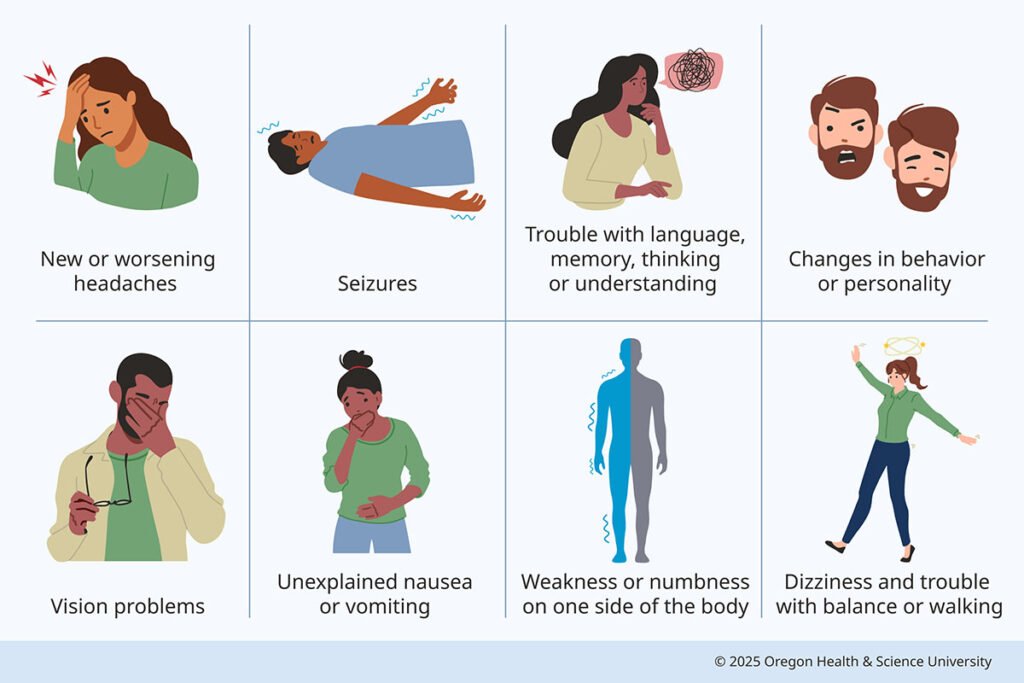
Before getting into gender-specific differences, here are the symptoms that can appear in anyone with a brain tumor:
- Persistent or worsening headaches, especially in the morning
- Nausea and vomiting without an obvious cause
- Seizures for the first time in an adult
- Vision problems — blurred vision, double vision, or loss of peripheral vision
- Confusion or memory problems
- Difficulty speaking or understanding speech
- Weakness or numbness on one side of the body
- Personality or behavior changes
- Loss of balance or coordination
- Extreme fatigue that does not improve with rest
If you or someone you know has any of these symptoms consistently for more than two weeks, consult a neurosurgeon immediately.
Brain Tumor Symptoms Specific to Women
1. Symptoms Mistaken for Hormonal Issues
This is the most dangerous trap women fall into. Meningiomas — the most common brain tumor in women — grow slowly and can produce symptoms that look identical to hormonal fluctuations:
- Mood swings and irritability
- Irregular menstrual cycles
- Brain fog and difficulty concentrating
- Unexplained weight changes
- Fatigue that feels like PMS or perimenopause
Women often live with these symptoms for months or even years before a brain tumor is discovered because both they and their doctors attribute the symptoms to hormones.
2. Hearing and Vision Changes
Acoustic neuromas, which are more common in women, grow on the nerve connecting the ear and brain. Early symptoms include:
- Ringing in one ear (tinnitus)
- Gradual hearing loss in one ear
- Feeling of fullness in the ear
- Balance problems and dizziness
These are frequently dismissed as ear infections or age-related hearing loss.
3. Pituitary Tumor Symptoms in Women
Pituitary adenomas — tumors at the base of the brain — affect hormonal output directly. In women, this can show up as:
- Sudden stopping of menstrual periods (amenorrhea)
- Unexpected breast milk production when not pregnant or breastfeeding (galactorrhea)
- Infertility or difficulty conceiving
- Significant unexplained weight gain
- Loss of sex drive
These symptoms are uniquely female and should immediately prompt an MRI of the brain if no other hormonal cause is found.
4. Depression and Anxiety Misdiagnosis
Women with frontal lobe or limbic system tumors often present with what looks like clinical depression or severe anxiety — crying spells, social withdrawal, extreme worry, or emotional flatness. Because women are statistically more likely to be diagnosed with anxiety and depression, these neurological symptoms are often missed for years.
5. Headaches Around the Menstrual Cycle
Many women already experience menstrual migraines, which makes it harder to identify when a headache has changed character. A brain tumor headache tends to:
- Be worse in the morning
- Wake you from sleep
- Not respond to regular pain medication
- Get worse when bending forward or lying down
- Come with nausea or vomiting
If your headache pattern suddenly changes, take it seriously regardless of where you are in your cycle.
Brain Tumor Symptoms Specific to Men
1. Personality and Behavior Changes
Men are more likely to develop glioblastomas and frontal lobe tumors. These tumors affect the part of the brain that controls personality, decision-making, impulse control, and social behavior. In men, this can show up as:
- Sudden aggression or irritability
- Impulsive or reckless behavior
- Poor judgment in work or financial decisions
- Withdrawal from family and friends
- Apathy — complete loss of motivation or interest
These changes are often attributed to stress, depression, or midlife crisis before anyone thinks to investigate the brain.
2. Seizures as a First Symptom
Studies show that men with brain tumors are more likely to experience a seizure as their very first symptom compared to women. This is partly because men tend to seek care later — by the time they do, the tumor has grown enough to trigger seizure activity. If a man with no history of epilepsy suddenly has a seizure, a brain tumor must be ruled out immediately.
3. Cognitive Decline and Memory Problems
Men with brain tumors frequently show early signs of:
- Forgetting names, appointments, or conversations
- Getting lost in familiar places
- Difficulty with planning or problem-solving
- Slowed thinking and reduced processing speed
This is often dismissed as work stress or early-onset dementia. In reality, cognitive changes in a man under 60 should always trigger a neurological evaluation.
4. Physical Weakness and Coordination Problems
Men with parietal or motor cortex tumors often present with:
- Weakness in one hand or arm
- Clumsiness or dropping objects frequently
- Difficulty with fine motor tasks like writing or buttoning shirts
- Dragging one foot while walking
Many men interpret this as a sports injury, pinched nerve, or tiredness — delaying diagnosis significantly.
5. Vision Problems
Men are more likely to develop tumors in the occipital lobe (vision processing area) or optic pathway. Symptoms include:
- Sudden loss of vision in one eye or one side
- Seeing flashes of light
- Double vision without an obvious eye problem
- Difficulty reading despite normal eyesight
Side-by-Side Comparison
| Symptom | More Common in Women | More Common in Men |
|---|---|---|
| Hormonal disruption | Yes — irregular periods, galactorrhea | No |
| Hearing loss / tinnitus | Yes — acoustic neuroma | Less common |
| Personality/behavior change | Less prominent | Yes — frontal lobe tumors |
| Seizures as first symptom | Less common | More common |
| Mood changes mistaken for depression | Yes — often misdiagnosed | Less common |
| Cognitive decline | Present | More prominent early |
| Physical weakness | Present | More prominent early |
| Pituitary symptoms | Yes — infertility, amenorrhea | Testosterone changes, erectile issues |
| Meningioma symptoms | 3x more common | Less common |
| Glioblastoma symptoms | Less common | More common |
Symptoms That Are Emergencies — For Everyone
Regardless of gender, go to the emergency room immediately if you experience:
- A sudden, extremely severe headache described as the worst headache of your life
- Sudden loss of vision, speech, or consciousness
- A seizure with no prior history
- Sudden paralysis or numbness on one side of the body
- Sudden confusion or inability to recognize familiar people or places
These are neurological emergencies. Do not wait. Do not drive yourself. Call an ambulance.
When to See a Neurosurgeon
You do not need to wait for an emergency to consult a neurosurgeon. See one if:
- You have had persistent morning headaches for more than 2 weeks
- You had a seizure for the first time in your life
- A neurologist found something on an MRI and referred you
- You are experiencing unexplained neurological symptoms that no other doctor has explained
- You want a second opinion on a brain tumor diagnosis
An MRI of the brain with contrast is the gold standard test for detecting brain tumors. It is safe, painless, and provides a clear picture of any abnormal growth.
Dr. Shyam’s Perspective
As a neurosurgeon with over a decade of experience treating both men and women with brain tumors, one pattern stands out repeatedly: delayed diagnosis.
Women come in after months of being told it is hormonal. Men come in after being told it is stress. By then, tumors that could have been treated with minimal intervention have grown significantly.
The message is simple: know your body. When something feels persistently wrong — a headache that will not leave, a personality shift that is out of character, a vision change that came from nowhere — trust that feeling and get evaluated. A 30-minute MRI can provide answers that months of guessing cannot.
Early detection does not just improve outcomes. In many cases, it is the difference between a manageable procedure and a life-altering surgery.
Overall, brain tumors are slightly more common in men. However, specific types like meningioma are significantly more common in women.
There is no conclusive evidence that oral contraceptives directly cause brain tumors. However, some hormone-sensitive tumors like meningiomas may grow faster in the presence of estrogen.
Brain tumor symptoms are not one-size-fits-all. Women face the unique challenge of symptoms that mimic hormonal conditions. Men face the challenge of symptoms that look like stress, aging, or personality issues. Both face a healthcare system that does not always connect the dots quickly enough.
The most powerful thing you can do is be informed. Know the symptoms. Know the differences. And when something does not feel right, seek expert help without delay.
If you or a loved one is experiencing any of the symptoms described in this article, contact Dr. Shyam — a board-certified neurosurgeon based in Madurai with international fellowship training — for a consultation or second opinion.
